Year-End 2025: Are You Owed Hours or Money?
We're about to close 2025, and for many workers this is the moment of truth: how many hours have you actually worked this year? If your company does annual hours reconciliation, now is when it's verified whether you've worked more (or less) than you should according to your contract.
In this article, we explain step by step how to calculate your 2025 hours balance and, if you're owed money or time, how to claim it before the year closes.
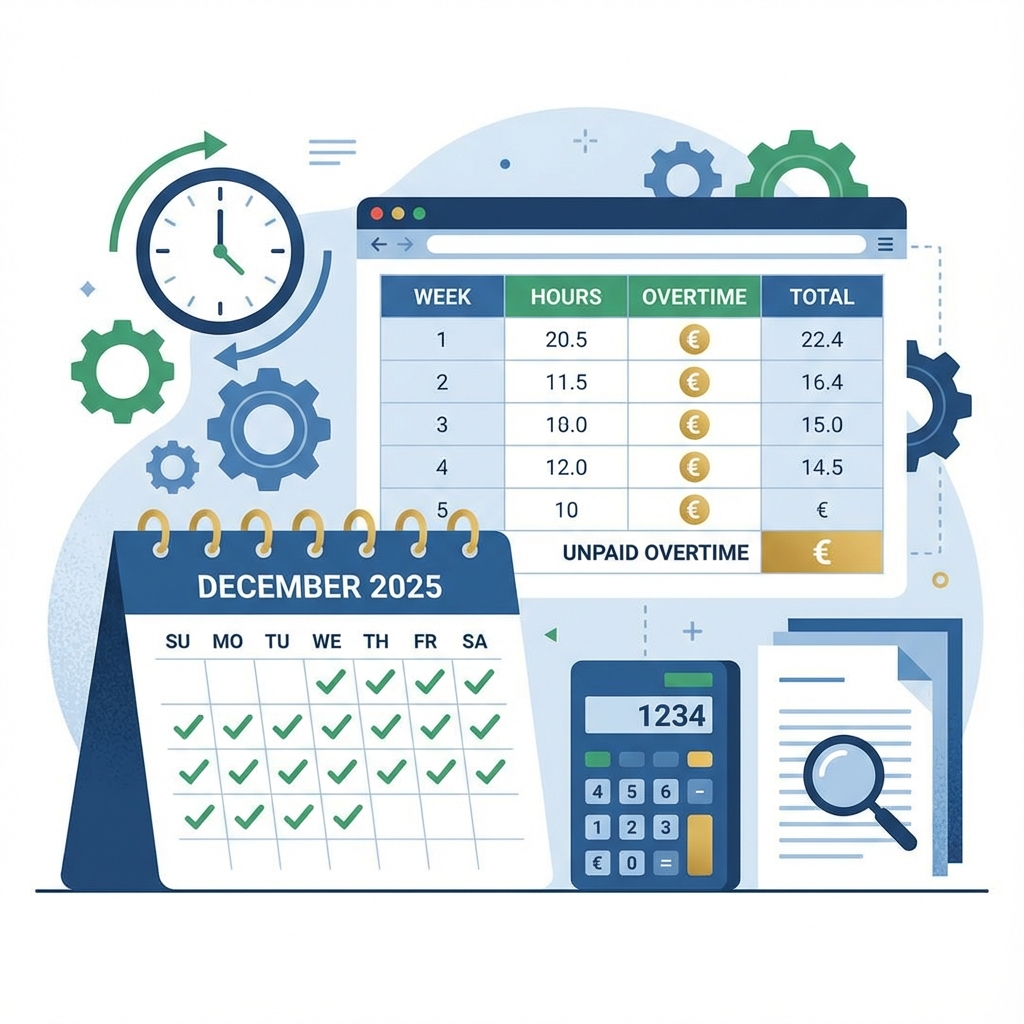
What is Annual Hours Reconciliation?
Hours reconciliation is the process by which the total hours you should have worked according to your contract are compared with the hours you actually clocked during the year.
Practical example:
- Contract: 40 hours per week (approximately 1,760 annual hours)
- Actual hours worked in 2025: 1,820 hours
- Result: +60 overtime hours that the company must compensate you for
Step 1: Calculate Your Theoretical Annual Hours
First, you need to know how many hours you should have worked according to your contract:
- Identify your weekly schedule: Check your contract (e.g., 40h/week)
- Multiply by weeks in the year: 40h × 52 weeks = 2,080 gross hours
- Subtract holidays and vacation:
- National holidays: ~14 days × 8h = 112 hours
- Vacation: 22 days × 8h = 176 hours
- Total to subtract: 288 hours
- Result: 2,080 - 288 = 1,792 theoretical annual hours
💡 Tip: Use our time calculator to quickly convert your decimal hours to hours:minutes format.
Step 2: Add Up Your Actual Hours Worked
Now you need the total hours you've clocked in 2025:
- Option 1: Request your annual time tracking report from HR
- Option 2: If you have access to the time tracking system, export data from January to December
- Option 3: If you keep manual records, add up all your workdays
If your time entries are in decimal format (e.g., 8.75 hours), use our calculator to convert them to hours and minutes and add them up correctly.
Step 3: Calculate Your Balance
Subtract your theoretical hours from your actual hours:
Balance = Actual Hours - Theoretical Hours
- Positive result (+): You've worked overtime → You're owed money or time
- Negative result (-): You've worked less → You might owe hours (depends on agreement)
- Zero result (0): Perfect balance
Step 4: What to Do if You're Owed Hours?
If your balance is positive, you have two options according to your agreement:
Option A: Financial Compensation
Overtime hours must be paid with a minimum surcharge of 75% on your base hourly salary. Check our article on how overtime is paid in Spain for more details.
Option B: Time Compensation
Some companies allow compensating overtime hours with days off. Normally an equivalence of 1.5 hours of rest per overtime hour worked is applied.
Step 5: How to Claim
If your company doesn't recognize your overtime hours:
- Gather evidence: Emails, time entries, witnesses
- Communicate in writing: Formal email to HR with your detailed calculation
- Give a reasonable deadline: 10-15 business days for response
- If no response: Consult with a labor lawyer or your union
Common Mistakes to Avoid
- ❌ Not keeping evidence of your time entries
- ❌ Trusting only the company's word
- ❌ Not reviewing your December payroll before year-end
- ❌ Letting the statute of limitations pass (1 year to claim wages)
Useful Tools
To facilitate your calculations, use:
- Decimal to Time Calculator - Convert your decimal hours
- Billable Hours Calculator - Calculate workdays with breaks
"Don't let them steal your time. Every hour worked deserves to be recognized and compensated."
Conclusion
Year-end is the perfect time to take stock. It's not about distrusting your company, but about exercising your right to know exactly how much you've worked. If you're owed hours, claim them. If everything is in order, you'll have the peace of mind of starting 2026 with clear accounts.
Need help calculating your hours? Try our free calculator and share this article with your colleagues who should also review their annual balance.