Decimal Hours: What They Are and How to Convert Hours and Minutes
What Are Decimal Hours?
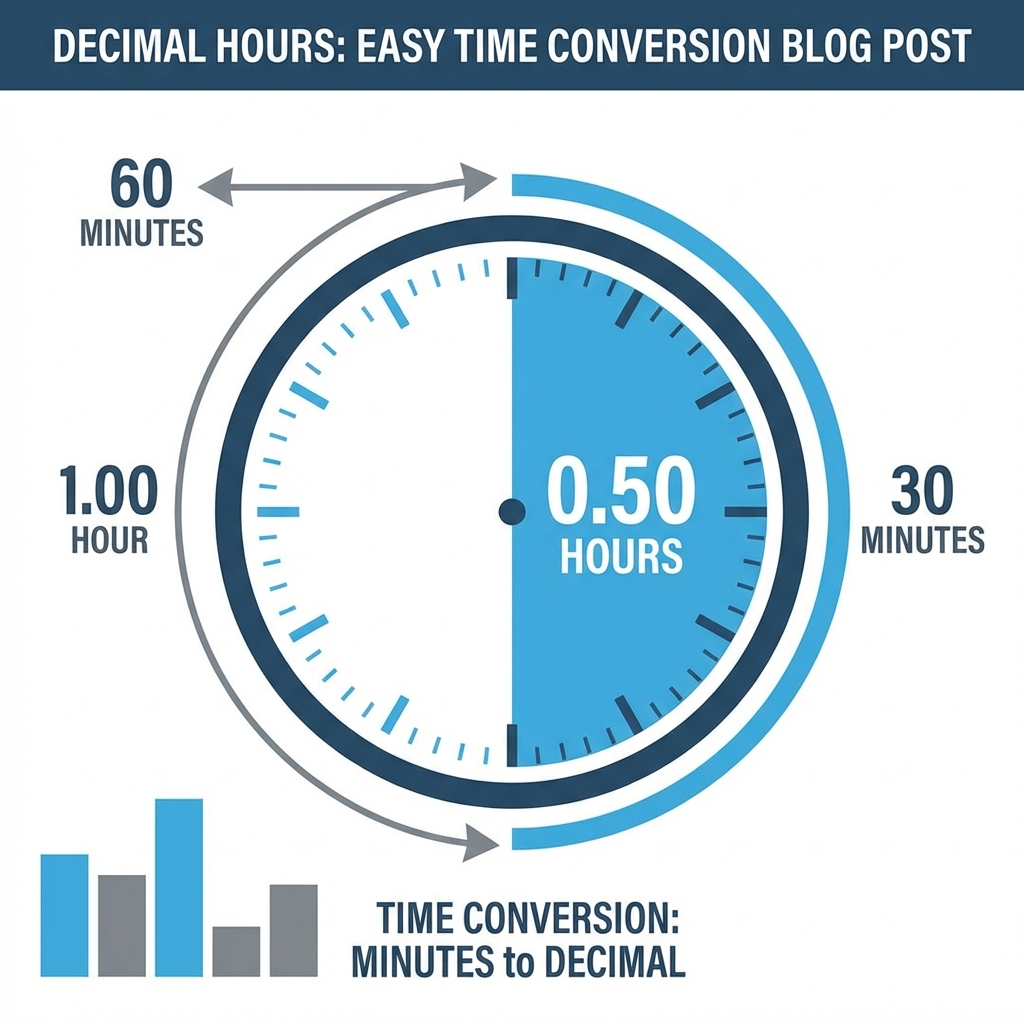
Decimal hours are a way of expressing time in a numerical format, where minutes are converted into fractions of an hour. This format is commonly used in tracking work hours, payroll, and labor calculations. For example, instead of saying "1 hour and 30 minutes", we would say "1.50 hours".
Why Are Decimal Hours Used in Work?
Using this format is essential in various work and administrative contexts:
- Time Tracking: It makes summing up work periods much easier than with the sexagesimal system (hours and minutes).
- Payroll: It facilitates salary calculation by multiplying hours worked by the hourly rate.
- Overtime: Simplifies the recording and payment of additional time worked.
- Invoicing: Essential for freelancers and companies that bill by time spent on projects.
How to Convert Hours and Minutes to Decimal Hours
The conversion is very simple if you follow this basic formula:
Minutes ÷ 60 = decimal fraction
Let's look at some simple examples:
- 30 minutes ÷ 60 = 0.50 hours
- 45 minutes ÷ 60 = 0.75 hours
- 15 minutes ÷ 60 = 0.25 hours
Practical Conversion Examples
When combining full hours with minutes, simply add the decimal part to the hour:
- 1 hour and 30 minutes = 1.50 decimal hours
- 2 hours and 15 minutes = 2.25 decimal hours
- 7 hours and 45 minutes = 7.75 decimal hours
Hours and Minutes Conversion Table
Here is a quick reference table for the most common conversions:
| Minutes | Decimal Hours |
|---|---|
| 5 min | 0.08 |
| 10 min | 0.17 |
| 15 min | 0.25 |
| 20 min | 0.33 |
| 25 min | 0.42 |
| 30 min | 0.50 |
| 35 min | 0.58 |
| 40 min | 0.67 |
| 45 min | 0.75 |
| 50 min | 0.83 |
| 55 min | 0.92 |
| 60 min | 1.00 |
How to Calculate Decimal Hours Automatically
If you don't want to do the manual conversion, you can use our decimal hours calculator to convert work hours and minutes quickly and accurately. Simply enter your start and end times, and we will do the calculation for you.
Difference Between Normal Hours and Decimal Hours
The main difference and source of confusion comes from the fact that our "normal" hours have 60 minutes,
while the decimal system is based on 100 units.
It is a common mistake to think that 1 hour and 50 minutes are 1.50 decimal hours. Not true!
1:50 hours = 1.83 decimal hours (because 50 ÷ 60 = 0.833...).
Common Conversion Mistakes
The most frequent error is treating the decimal point as a minutes separator.
- INCORRECT: Working 8 hours and 15 minutes and recording it as 8.15. (Actually, 8.15 hours is 8 hours and 9 minutes).
- CORRECT: 15 minutes divided by 60 is 0.25. Therefore, you should record 8.25 hours.
Decimal Hours FAQ
Why is 1.50 hours not 1 hour and 50 minutes?
Because the time system is sexagesimal (base 60) and the decimal system is base 100. 1.50 hours means "one and a half hours", which is 1 hour and 30 minutes.
How do I convert 20 minutes to decimal?
Simply divide the minutes by 60. In this case: 20 / 60 = 0.33 decimal hours.
Why do we convert to decimal hours?
It makes calculating payroll much easier. If you earn $10/hour and work 1 hour and 15 minutes, it's hard to multiply 10 x 1:15. However, if you convert it to 1.25 hours, the math is simple: 10 x 1.25 = $12.50.