2026 Resolutions: How to Achieve Work-Life Balance (For Real)
Every new year arrives with the same promise: "This year I'm going to have work-life balance". And every year, by mid-February, that promise evaporates like birthday candle smoke.
The problem isn't you. The problem is that you can't balance what you don't measure. If you're working 50 hours a week without knowing it, no meditation app is going to save you.
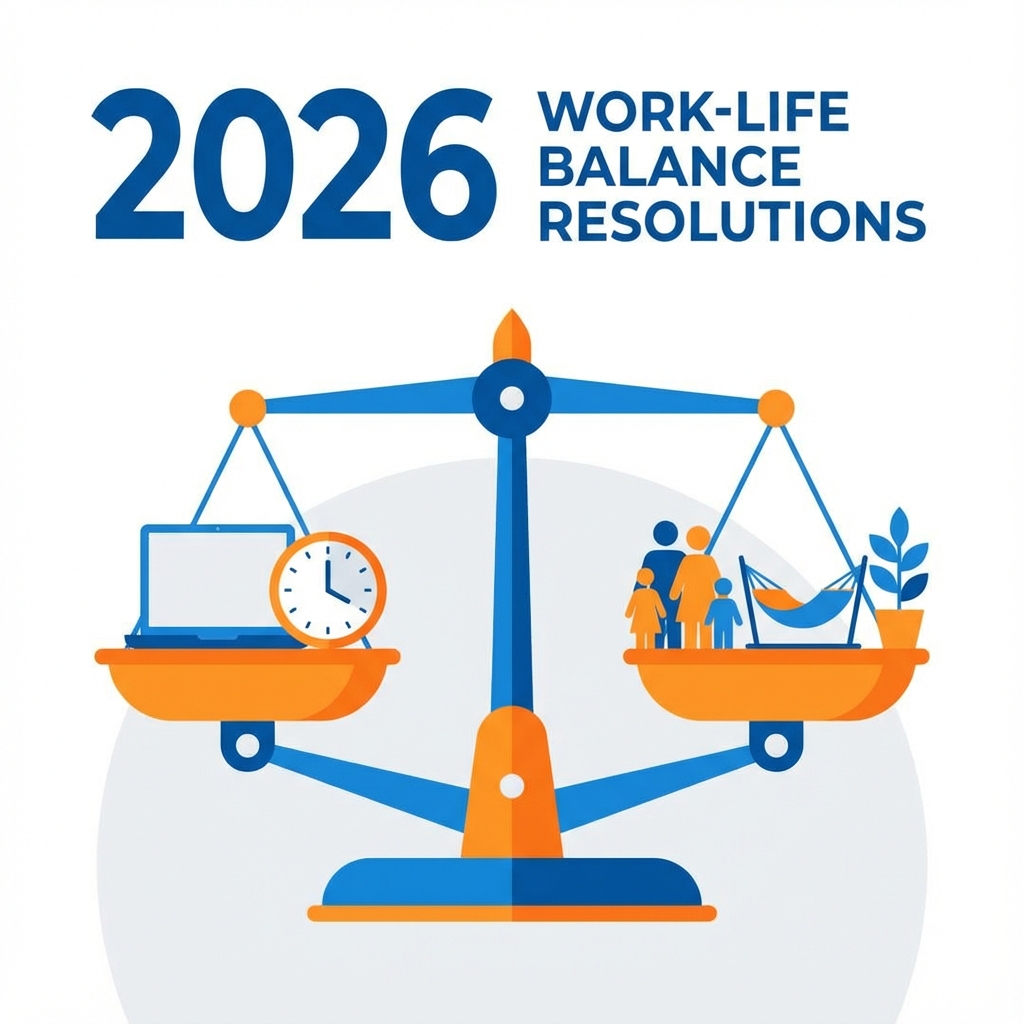
The Uncomfortable Truth About Work-Life Balance
Work-life balance isn't a feeling. It's pure mathematics:
Balance = Actual Time Worked ÷ Time You Should Work
If that number is greater than 1, you don't have balance. You have a problem that no productivity podcast is going to solve.
Why New Year's Resolutions Fail
Most resolutions fail because they're vague and emotional:
- ❌ "I'm going to work less" → How much is less? How do you measure it?
- ❌ "I'm going to spend more time with my family" → How much time? What counts as "quality time"?
- ❌ "I'm going to disconnect more" → Disconnect from what? When? How will you know if you've achieved it?
In contrast, resolutions that work are specific and measurable:
- ✅ "I'm going to work exactly 40 hours per week, not one more"
- ✅ "I'm going to dedicate 2 hours daily to my family without my phone"
- ✅ "I won't answer emails after 7:00 PM"
The 3-Number Method for 2026
Forget mantras and positive affirmations. To achieve real balance in 2026, you need to know and control these three numbers:
Number 1: Your Contractual Schedule
How many hours does your contract say you should work per week? If you don't know, look it up now. This is your reference point.
Example: 40 hours per week = 8 hours daily Monday to Friday.
Number 2: Your Actual Schedule
How many hours do you actually work each week? And I don't mean the ones you clock, but the ones you really dedicate to work:
- Time in the office or working remotely
- Emails answered outside hours
- Work calls during your "free time"
- Thinking about work problems while having dinner
If you don't track this, you're flying blind.
Number 3: Your Balance Ratio
Divide your actual schedule by your contractual schedule:
Ratio = Actual Schedule ÷ Contractual Schedule
- Ratio = 1.0: Perfect balance
- Ratio = 1.25: You work 25% more than you should (50h instead of 40h)
- Ratio = 1.5: You work 50% more (60h instead of 40h) → Danger zone
Your Action Plan for 2026
Here's your roadmap to achieve real balance this year:
Week 1 of January: Establish Your Baseline
- Review your contract and note your official schedule
- Install a time tracking app (or use our calculator)
- For 7 days, record ALL your actual work hours
- Calculate your current balance ratio
Weeks 2-4 of January: Identify Time Leaks
Analyze where your extra time goes:
- Unnecessary meetings?
- Emails outside hours?
- Tasks you could delegate?
- Perfectionism on low-impact tasks?
February Onwards: Protect Your Boundaries
Establish clear rules and communicate them:
- Availability hours: "I'm available from 9:00 AM to 6:00 PM"
- Response time: "I respond to emails within 24 business hours"
- Disconnection days: "I don't check email on weekends"
Practical Tools for Tracking
To track your hours in 2026, you can use:
- Decimal to Time Calculator - To convert your time entries
- Billable Hours Calculator - To calculate workdays with breaks
- Simple spreadsheet with columns: Date | Start Time | End Time | Total
The Resolution That Actually Works
Instead of "I'm going to have more balance", try this:
"In 2026, I'm going to work exactly the hours in my contract. I'm going to track my time every week and adjust when my ratio exceeds 1.1. I won't answer work emails after 7:00 PM or on weekends."
This is specific, measurable, and achievable. And most importantly: you can know if you're meeting it or not.
The Key Question for 2026
Before finishing, ask yourself this question:
"If I continue working at the current pace, where will I be in December 2026?"
If you don't like the answer, now is the time to change. Not in February. Not "when this project finishes". Now.
Additional Resources
"Balance isn't found. It's built. And it's built with data, not wishes."
Conclusion
2026 can be the year you finally achieve work-life balance. But it won't happen by magic. It will happen because you decided to measure, adjust, and protect your time.
Start today. Calculate your actual hours with our free calculator. Share this article with someone who needs to read it. And remember: what isn't measured can't be improved.